For students with an ALEKS placement or the TEAS coming up

Free ALEKS and TEAS math practice. Every step checked.

Lemma checks every step you write, not just the answer — so you see the exact move that’s costing you points, fix it, and move on.

Free. No account, no email. About a minute to your first problem. A phone works; a tablet with a pencil is the best seat. Dosage practice is practice only, not clinical advice.
  • 66ALEKS placement topics, foundations to precalculus
  • 23TEAS math topics, checked the same way
  • 15interactive TEAS science lessons
  • 4of them with a live 3D model

The problem

An answer key tells you that you missed. Not where.

Most practice checks the last line. If one move in the middle went wrong, you get a red X and a new problem — and you make the same move again on test day. Lemma reads every line against the one above it and stops at the first one that breaks.

Answer key

2x+18=30

x=24 ✗

Incorrect. The answer is x=6.

…but which move was it?

Lemma

2x+18=30

2x=48

Named: To clear 18 from the left side, subtract 18 from both sides: 30 - 18 = 12. Instead 18 was added to the right side: 30 + 18 = 48, so the two sides no longer balance.

2x=12

x=6

Your fast track

Tell it the score you need. See the path to your cutoff.

Pick your test, the score you need and the day you sit it. You get the topics in the order they build, what you can skip, and roughly how long it takes — from the same course plan the app runs. Solve a topic’s first problem cold and you skip its lesson, so the path gets shorter as you go.

Your test

Checkpoints 46, 61, 76 are the cutoffs at the college Lemma was built for; yours may differ. Above 76, the path is the same with more margin.

The path to your cutoff

49 topics, in order. About 21.1 hours of problems — 14.1 if every topic passes on its first four, 38.8 if sets need a second run.

Add your test date to see whether the path fits before it.

  1. Only if the map finds a hole

    Foundation repair7 items · not counted

    1. Integer operationsFoundations
    2. Order of operationsFoundations
    3. Add and subtract fractionsFoundations
    4. Multiply and divide fractionsFoundations
    5. Decimals and percentsFoundations
    6. Ratios and proportionsFoundations
  2. Up to 46

    Intermediate Algebra38 items · ~15.9 h

    1. Simplify algebraic expressionsAlgebra basics
    2. Distributive propertyAlgebra basics
    3. Combine like termsAlgebra basics
    4. Exponent product rulesAlgebra basics
    5. Negative exponentsAlgebra basics
    6. Scientific notationAlgebra basics

    Checkpoint 46 · Intermediate Algebra

  3. 46 → 61

    College Algebra11 items · ~5.2 h

    1. Function compositionFunctions
    2. Inverse functionsFunctions
    3. Exponential equationsExponentials & logs
    4. Exponential growth and decayExponentials & logs
    5. Evaluate logarithmsExponentials & logs
    6. Logarithm propertiesExponentials & logs

    Checkpoint 61 · College Algebra

Time is the app’s own estimate per problem, lesson and drill; lessons you choose to open add to it. It’s a plan, not a promise — the checker, not the clock, decides when a topic is done.

Try it · Two-step equations

Make a mistake on purpose. Watch it get caught.

Type the next line of work, or just the answer. A right line gets a check. A wrong line gets struck through, and Lemma names the move that broke it. You get three lines.

The answer looks like x = a single value.

Two identical notebooks and a $18 binder cost $30. What is the price of one notebook?

  1. given2x + 18 = 30

Every verdict comes from the same math checker the app uses — a computer algebra system, not an AI model. Nothing you type here is saved.

Or catch one yourself.

This is a real lesson page. One line of a worked example went wrong — tap the piece that broke. The sentence you get back is the checker’s own, word for word.

Catch the mistake

One move went wrong. Tap the part that is wrong.

Simplify -7 - (-3) + (-4).

Real lessons

Lessons that write the work out, one checked move at a time.

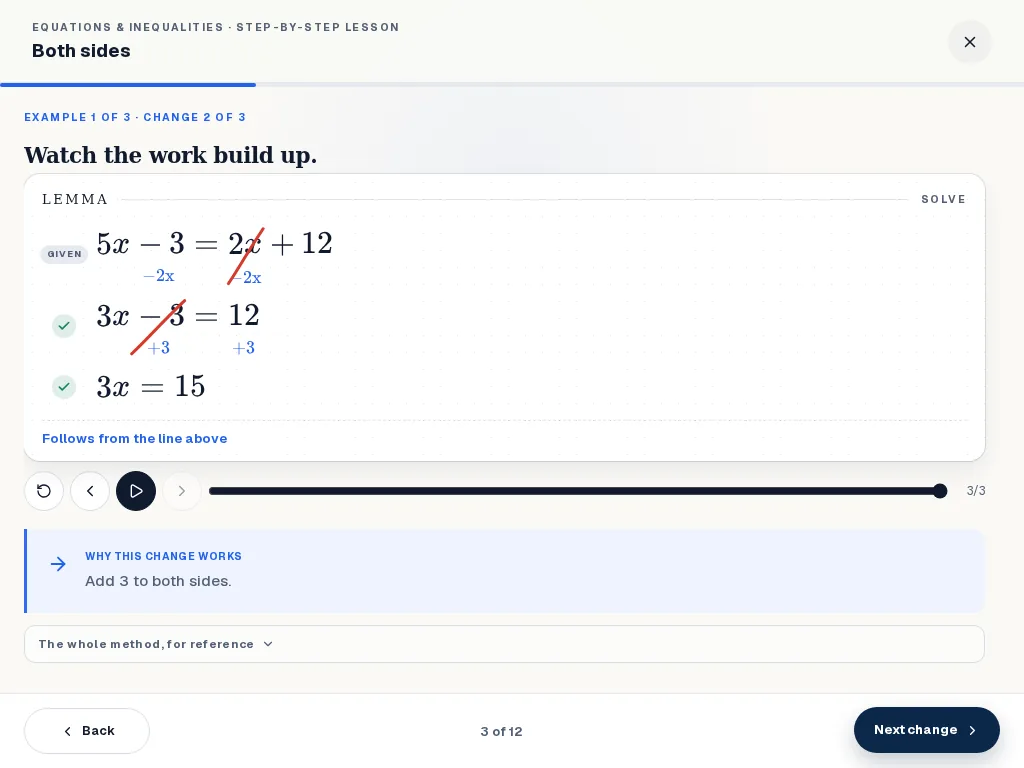
When you need a lesson, it plays like a tutor at a whiteboard: the move written under both sides, the pair that cancels struck out, the next line ticked. Every line on these boards was proved by the checker before the lesson shipped.

Solve

Two-step equations

Two-step equations · change 1 of 2

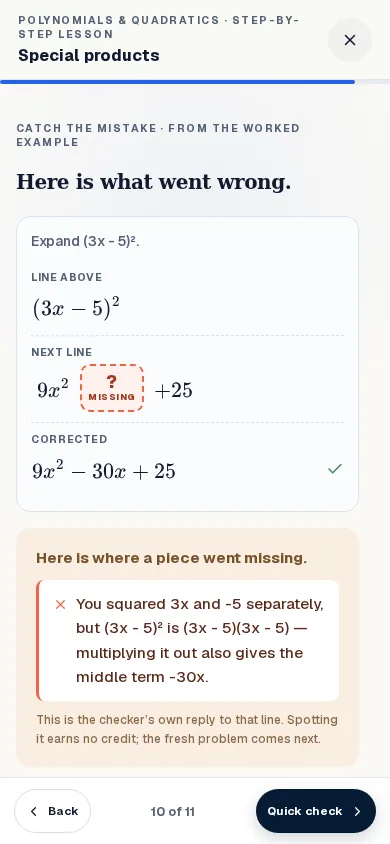
A catch-the-mistake page on a phone: the missing middle term of (3x − 5)² is marked, with the checker’s sentence and the corrected line.
Catch the mistake, on a phone
A step-by-step lesson on a tablet: 5x − 3 = 2x + 12 worked to 3x = 15, each change written under both sides and ticked.
A worked example, mid-lesson

TEAS science

Science you can turn over in your hands.

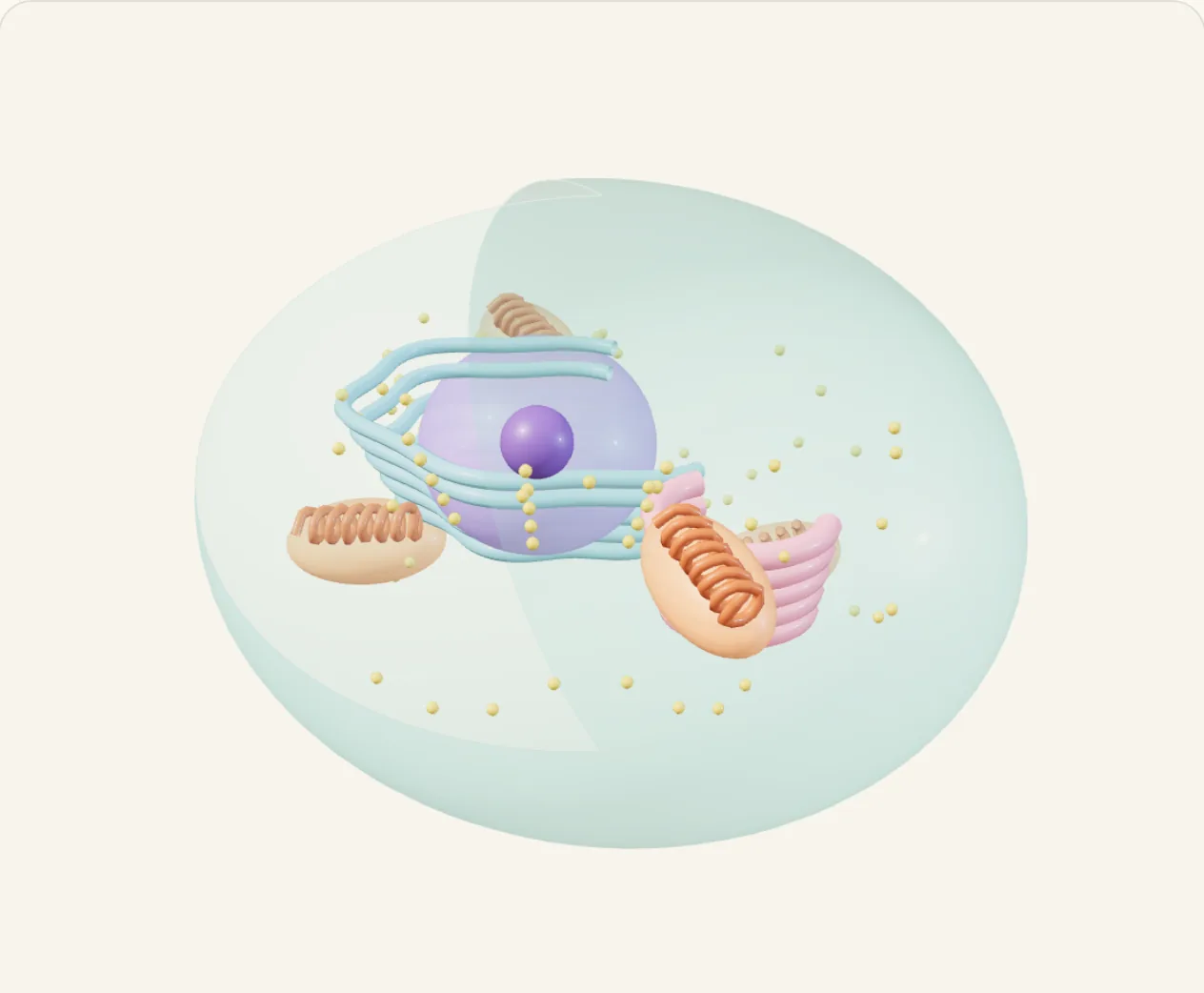
The TEAS science lessons are interactive: follow blood through the heart, air down to the alveoli, water through the kidney, and pick apart a cell. 4 of them run a live 3D model — this is the cell, straight from its lesson.

The 3D animal cell from the lesson: nucleus, mitochondria, rough ER, Golgi apparatus and ribosomes inside the membrane.

Pick a structure

Each one is labelled on the model and explained in plain words. In the lesson, three situations follow: which structure’s job failed?

  • Heart & bloodTwo circuits, one heart
  • Respiratory systemA breath, from air to blood
  • Renal & reproductiveFilter, reclaim, excrete
  • Cells & macromoleculesInside the cell · Across the membrane

Syllabus

Everything it covers, in the order you meet it.

Every unit and topic below is read from the course itself. ALEKS placement is 66 topics from signed numbers to the unit circle, plus 18 optional Calculus I topics; the TEAS math course is 23 of them in its own order, beside the science, reading and English decks. Each math topic below has its own practice page: an explanation, a worked example, and a sample problem.

466176
ALEKS checkpoint it builds toward
fdn
Foundation repair, only if the map finds a hole
TEAS
In the TEAS math course
Calc I
Optional, after placement

Math 20 units · 92 topics

  1. Foundations

    7 topics

    1. Integer operationsfdnTEAS
    2. Order of operationsfdnTEAS
    3. Add and subtract fractionsfdnTEAS
    4. Multiply and divide fractionsfdnTEAS
    5. Decimals and percentsfdnTEAS
    6. Ratios and proportionsfdnTEAS
    7. Unit conversionsfdnTEAS
  2. Algebra basics

    6 topics

    1. Simplify algebraic expressions46TEAS
    2. Distributive property46TEAS
    3. Combine like terms46TEAS
    4. Exponent product rules46
    5. Negative exponents46
    6. Scientific notation46
  3. Equations & inequalities

    7 topics

    1. One-step equations46TEAS
    2. Two-step equations46TEAS
    3. Variables on both sides46TEAS
    4. Literal equations46TEAS
    5. Absolute-value equations46
    6. Linear inequalities46TEAS
    7. Compound inequalities46
  4. Lines & systems

    6 topics

    1. Coordinate geometry: midpoint, distance, endpoints46
    2. Slope from two points46
    3. Equations of lines46
    4. Read linear graphs46
    5. Systems by substitution46
    6. Systems by elimination46
  5. Functions

    5 topics

    1. Function notation and evaluation46
    2. Function domain and range46
    3. Function transformations46
    4. Function composition61
    5. Inverse functions61
  6. Polynomials & quadratics

    9 topics

    1. Add and subtract polynomials46
    2. Multiply polynomials46
    3. Factor the greatest common factor46
    4. Special polynomial products46
    5. Factor quadratic trinomials46
    6. Difference of squares46
    7. Solve quadratics by factoring46
    8. Complete the square46
    9. Quadratic formula46
  7. Radicals

    3 topics

    1. Simplify radicals46
    2. Radical arithmetic46
    3. Radical equations46
  8. Advanced algebra

    3 topics

    1. Complex-number arithmetic46
    2. Polynomial division61
    3. Zeros and factors of polynomials61
  9. Rational expressions

    3 topics

    1. Simplify rational expressions46
    2. Rational-expression operations46
    3. Rational equations46
  10. Exponentials & logs

    5 topics

    1. Exponential equations61
    2. Exponential growth and decay61
    3. Evaluate logarithms61
    4. Logarithm properties61
    5. Logarithmic equations61
  11. Advanced functions

    3 topics

    1. Polynomial function behavior61
    2. Rational functions and asymptotes61
    3. Arithmetic and geometric sequences76
  12. Trigonometry

    4 topics

    1. Right-triangle trigonometry76
    2. Degrees and radians76
    3. Unit-circle values76
    4. Trigonometric identities76
  13. Advanced trigonometry

    4 topics

    1. Amplitude, period, and phase76
    2. Solve trigonometric equations76
    3. Laws of sines and cosines76
    4. Angle-sum and double-angle formulas76
  14. Analytic geometry

    1 topic

    1. Circles and conic sections76
  15. Limits & continuity

    3 topics

    1. Limits by direct substitutionCalc I
    2. Limits by algebraic simplificationCalc I
    3. Continuity and removable breaksCalc I
  16. Derivatives

    7 topics

    1. Derivative from the limit definitionCalc I
    2. Power rule and polynomial derivativesCalc I
    3. Product ruleCalc I
    4. Quotient ruleCalc I
    5. Chain ruleCalc I
    6. Derivatives of trigonometric functionsCalc I
    7. Exponential and logarithmic derivativesCalc I
  17. Derivative applications

    4 topics

    1. Implicit differentiationCalc I
    2. Tangent and normal linesCalc I
    3. Related ratesCalc I
    4. OptimizationCalc I
  18. Integrals

    4 topics

    1. AntiderivativesCalc I
    2. Definite integrals and net areaCalc I
    3. Fundamental theorem of calculusCalc I
    4. Substitution in integralsCalc I
  19. Measurement & data

    5 topics

    1. Perimeter, area, and volumeTEAS
    2. Mean, median, and spreadTEAS
    3. Read tables and chartsTEAS
    4. Perimeter and circlesTEAS
    5. Mode, range, and mediansTEAS
  20. Applied arithmetic

    3 topics

    1. Percent increase and decreaseTEAS
    2. Doses, rates, and conversionsTEAS
    3. Mixed numbersTEAS

Science, reading & English 15 interactive lessons · 4 with live 3D models · 20 drill decks

TEAS science

  1. Body organization

    7-screen lesson · 27 drill cards

    A language of directionsThree ways to cutWhich cavityTissue lensPlace the woundFeedback loopWhat you learned

  2. Heart & blood

    7-screen lesson · 35 drill cards 3D

    Two circuits, one heartBe a red blood cellThe sparkWhat blood isMatch blood typesAn O-negative patientWhat you learned

  3. Respiratory system

    7-screen lesson · 26 drill cards 3D

    A breath, from air to bloodThe gas swapBreath LabThe CO₂ driveOrder the airwayDraw the airwayWhat you learned

  4. Digestive system

    7-screen lesson · 27 drill cards

    From food to absorbed nutrientsAbsorb itForm the stoolThe workersThe helpersOrder the roadWhat you learned

  5. Nervous system

    7-screen lesson · 26 drill cards

    The relayThe parts at workThe gapThree floorsThe reflex arcTwo settingsWhat you learned

  6. Endocrine · signals that restore balance

    5-screen lesson · 17 drill cards

    Trace a hormone's routeRead the feedbackRestore the fuel balanceSeparate signal from targetRetrieve without the diagram

  7. Immune defense · recognition and memory

    5-screen lesson · 16 drill cards

    Follow the defenseA recognition errorReplay an antigen encounterWho made the antibodies?Retrieve the mechanisms

  8. Renal and reproduction · trace what moves

    6-screen lesson · 16 drill cards 3D

    Filter, reclaim, excreteFollow urine to the exitCells and developmental journeysFollow sperm to the exitTwo kinds of cell divisionRetrieve both pathways

  9. Muscle, bone and skin · force and renewal

    5-screen lesson · 17 drill cards

    Connect the supporting tissuesSlide without shrinkingExplain coolingDistinguish tissue jobsRetrieve force and layers

  10. Cells & macromolecules

    11-screen lesson · 23 drill cards 3D

    Inside the cellAcross the membraneSalty or fresh outsideA wilted plant in plain waterMoving uphillFour material familiesShape makes functionWhere cells make ATPOrder the stepsA cell with no mitochondriaPut the system together

  11. Genetics · information and inheritance

    9-screen lesson · 20 drill cards

    Read a molecular messagePredict an inheritanceSeparate probability from a promiseMitosis versus meiosisPut the phases in orderWhere the shuffling happensX-linked Punnett squaresWhere a son's X comes fromRetrieve without the model

  12. Atoms & bonds · identity, charge, attraction

    5-screen lesson · 13 drill cards

    Account for every particleSeparate three attractionsPredict a periodic trendTrack what evaporation changesRetrieve without the model

  13. Matter & reactions · what changes, what stays

    8-screen lesson · 13 drill cards

    Keep an atom ledgerSort five reaction patternsRead an energy diagramRead a logarithmic scaleCount what neutralization uses upRead instruments and convert unitsSeparate rate from energyRetrieve without the model

  14. Scientific reasoning

    7-screen lesson · 45 drill cards

    One change, one measureRun itA second experimentMeasure itRead the tableThe hypothesisWhat you learned

  15. Microbes · structure, carriers and harm

    5-screen lesson · 12 drill cards

    Compare microbial structuresTrace the exposure routeSeparate toxin mechanismsAbility versus degree of harmRetrieve from structure

TEAS reading

  1. Reading anchors

    14 drill cards

    Where main ideas live, fact versus opinion, transitions, and text features.

  2. Craft & sources

    13 drill cards

    Tone, point of view, source types, appeals, and evidence discipline.

TEAS English & language usage

  1. Conventions & punctuation

    22 drill cards

    Commas, apostrophes, semicolons, capitalization, and sentence structure.

  2. Spelling rules

    12 drill cards

    The rule families: i-before-e, silent e, doubling, y-to-i, and plurals.

  3. Language & vocabulary

    18 drill cards

    Grammar choices, word parts, tone, and words in context.

How it works

Four rules Lemma never bends.

They are why a fast path is still a real one: what counts toward your cutoff is only what you did on your own.

  1. Try it first

    Every topic opens on one problem, with no lesson. Solve it on your own and you skip the lesson.

  2. Help is marked, never hidden

    Ask for a hint and that problem is marked as solved with help. It still teaches you; it just doesn’t count as yours alone.

  3. Nothing unearned counts

    A topic passes on four fresh problems solved without help. Nothing else moves you along.

  4. Wrong steps get named

    A wrong line isn’t just marked wrong. When Lemma can tell which move broke it, it says so, and that mistake comes back later as its own practice.

When you’re stuck

A tutor for when you’re stuck. Never the grader.

Ask about the problem you’re on by typing, by talking out loud, or by writing on the page and letting it read your handwriting. It explains; the math checker alone decides what’s right. The tutor is an AI model, so it can be wrong — the checker can’t be talked out of a verdict.

Free every day: 10 questions, 3 voice sessions, and 40 handwriting reads.

Why this exists

I built the tool that wouldn’t let me fake it.

A kitchen table at night: an open graph-paper notebook, a pencil, a tablet with its stylus, and a cup of tea under a lamp.

I’m preparing for ALEKS placement so I can qualify for Calculus I. I needed a way to see which steps I understood and which ones still depended on help.

Every tool I tried let me fake it. The hint was one tap away before I had written anything. The answer key said I was right without asking how I got there — and on the day, how you got there is the only thing that shows up.

So I built one that refuses. A computer algebra system checks each line against the line above. It won’t help until you’ve tried. And it keeps what you did with help apart from what you did alone, because the test only sees the second kind.

The first learner on it is me: relearning algebra from zero, working toward a 76 or better on ALEKS placement. It’s open now in case it helps you too.

—
steps checked
—
problems proved

Every number on this page is real and live.

What’s here today

What’s in it today.

Math for ALEKS placement: 66 topics with unlimited fresh problems, plus 18 optional Calculus I topics. TEAS: a math track plus 15 interactive science lessons and drills; Reading passages are next.

Start free — no account, no email

Pick your test

Which one is between you and the program?

No sign-up. A cookie keeps your place in this browser; Account inside the app gives you a link to open the same record on another device.

Questions

Straight answers.

What is Lemma?

Lemma is a free web app for ALEKS placement and TEAS math practice. You type each step of a solution; a computer algebra system checks every line, shows exactly where it went wrong, and names the mistake when it can tell which move broke it. Help unlocks only after you try, and it won’t hand you the answer. No account, no email.

Is there free ALEKS placement practice that checks each step?

Yes. Lemma covers 66 ALEKS placement topics with unlimited fresh problems, in the order they build, with checkpoints at 46+ Intermediate Algebra, 61+ College Algebra, 76+ Precalculus, plus 18 optional Calculus I topics. Every line you type is checked by a computer algebra system, not an AI model, and a topic passes only on four fresh problems solved without help.

Can I practice TEAS math on Lemma?

Yes. The TEAS side has its own math track of 23 topics (ratios, percentages, unit conversion, algebra and more), checked step by step the same way, plus 15 interactive science lessons and drills. Reading passages are next.

Is Lemma free?

Yes. Every lesson, problem and review is free. The AI tutor is free too, up to a daily limit: 10 questions, 3 voice sessions and 40 handwriting reads a day.

How is Lemma different from asking ChatGPT to check my math?

A chatbot’s verdict on your step is a language model’s guess, and it will usually just give you the answer. In Lemma the verdict on every line comes from a computer algebra system. The AI tutor explains and hints but never grades, any help marks that problem as assisted, and only problems you solve on your own move you forward.

Do I need an account?

No. Pick ALEKS or TEAS and your first problem opens in about a minute. A cookie keeps your place in this browser, and Account inside the app gives you a link to open the same record on another device. A phone works; a tablet with a pencil is the best seat.

Is Lemma affiliated with ALEKS or the TEAS?

No. Lemma is independent practice. ALEKS is a registered trademark of McGraw Hill, and TEAS is a registered trademark of Assessment Technologies Institute (ATI).

Optional

Get notified when full access opens

Leave an email address and it is used for one thing: telling you when full access opens. Studying here still needs no account and no email.